

Arbitration in basketball: main rules, signals and controversial situations, how to really master them?
Who has never yelled at a referee's decision during a basketball game? Players, coaches, or fans, everyone thinks they understand the rules, but the world of refereeing often remains a mystery. Yet, it is the referees who hold the reins of the game. They decide, whistle, point fingers - in short, they enforce the rules and pace every second of the game. But what laws really govern their decisions? What signals do they use? And what happens when doubt arises over a contentious play? Are you curious? Perfect, let's dive into this world we think we know... but not quite.
Basketball refereeing: main rules, signals, and controversial situations
Refereeing essentials: understanding the main rules
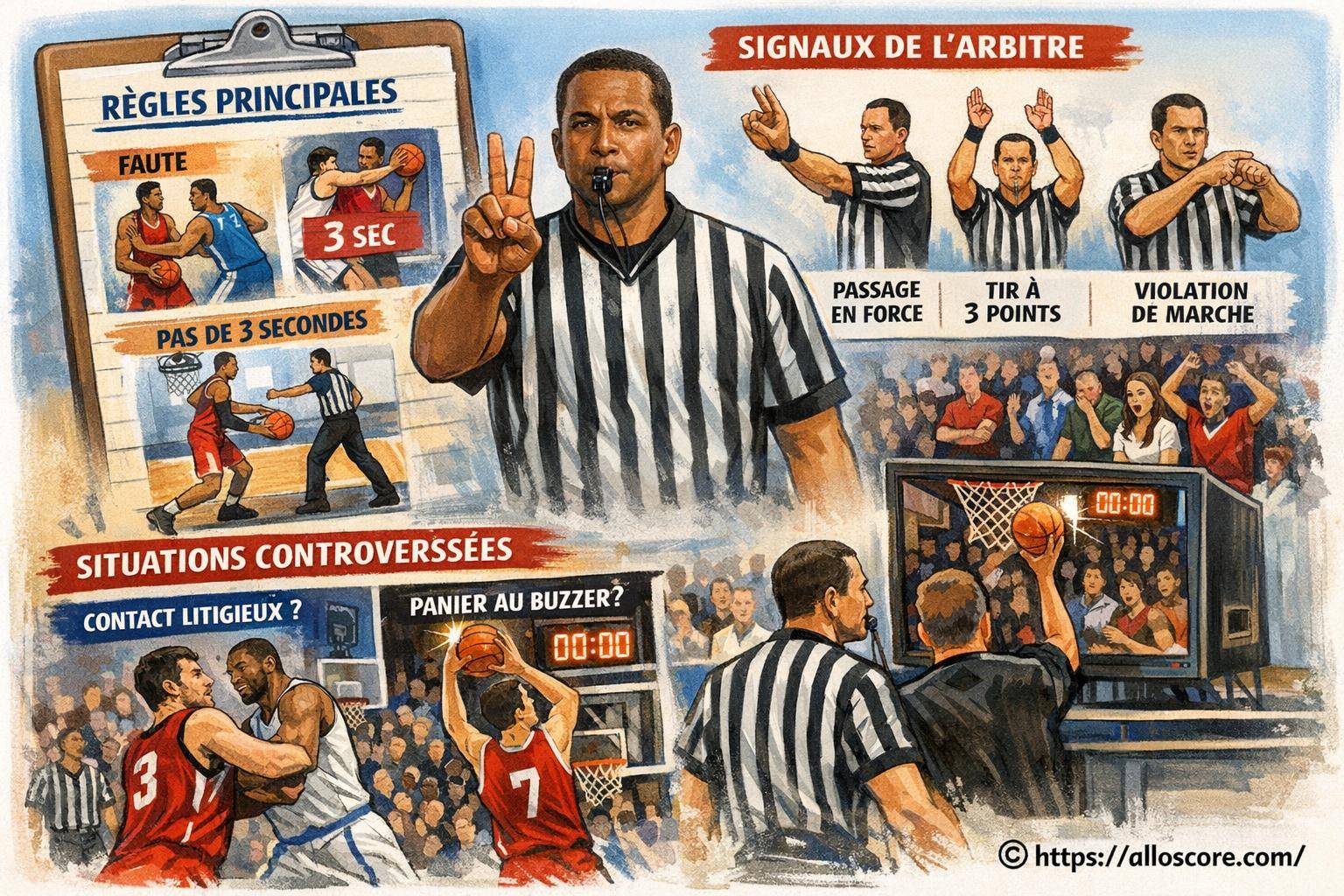
The referee is the guardian of the game. They keep a close watch to ensure everything happens by the book, no more, no less. The fundamentals of basketball refereeing revolve around a few key points.
- Traveling violation: It is forbidden to take more than two steps without dribbling. If the player's pivot foot lifts before the ball, immediate penalty!
- Personal fouls: Whether it's a push, arm obstruction, or charging, illegal contacts are tracked down to the millimeter.
- The 24-second rule: The attacking team has a limited time to shoot. At the slightest hesitation, the clock is decisive.
- Backcourt violation: Once the ball has crossed the midline, you cannot go back or risk losing possession.
- Out of bounds: If the ball or a player touches the line, possession goes to the opponent.
Of course, there are other more detailed regulations, but these form the foundation of both competitive and recreational basketball. The referee, often assisted by one or even two colleagues, must keep every subtlety in mind while maintaining exemplary neutrality.
Referee language: signals to know
The codified gestures of referees, true punctuation marks of the game, always intrigue novices. It is impossible to understand what is happening without decoding this funny - and sometimes theatrical - body language! Here are some essential signals to recognize:
- Raised arm: Announces a personal foul, usually accompanied by the offender's number.
- Open fingers pointed in a direction: Indicates the team that gains possession. Simple, but you have to follow!
- Arm rotation: Iconic, this gesture signals the 24-second violation or a dribble restart.
- Circle made with the finger: Used to signal a three-point basket, after verifying the shooter's foot position.
- Both hands on shoulders: Means a player has committed an unsportsmanlike foul, often with serious consequences.
- Palm facing down: Request to stop the game or to delay.
A good referee must, under all circumstances, combine clarity and firmness in their gestures - no room for ambiguity!
Curiously, some signals remain sources of confusion, especially in the heat of the moment. Experienced spectators often enjoy guessing the decision even before the official announcement... sometimes wrongly!

Controversial situations and pressure on the refereeing team
Where things get complicated is when the rule borders on interpretation. Contentious situations abound, each offering material for passionate debates. A few examples among many:
- Uncalled traveling: Some crafty players mask their irregular movement with deceptive dribbles. The referee must have a keen eye... and ears alert to the crowd's reactions!
- Offensive vs defensive foul: When a player charges toward the basket and bumps into a defender, who is at fault? The answer and accompanying gestures often make both sides groan.
- Flopping (simulation): Some do not hesitate to fall exaggeratedly to get a foul. The referee must then exercise judgment and decide whether to penalize or not.
- Contact during three-point shots: Gosh, this kind of action at full speed can give any official gray hairs!
You understand, refereeing is not just about applying rules; it is also managing pressure, shouting, and emotion. Far from infallible, men and women with whistles practice a profession where every decision can go viral... and be endlessly dissected on social media.
Video review: an ally... or a new source of controversy?
Technology has entered the courts. Video now allows referees to review key plays before deciding. But is it always a good thing? Yes... and no. On one hand, it reduces obvious errors on buzzer-beaters or blatant fouls. On the other, some believe it breaks the rhythm and adds a new source of controversy.
It is a bit of a modern paradox. We expect referees to be perfect, while sometimes asking them to judge in a fraction of a second what twenty cameras watch in slow motion. But that is also what makes basketball thrilling. By the way, have you ever seen an entire arena change atmosphere on a decision corrected after video review? The suspense is total.
[ En savoir plus ici ]
The social role and the place of women in refereeing
Referees are often thought of as neutral and discreet figures. But the reality is much more colorful. Today, diversity is gaining ground in the refereeing world. Women, in particular, are taking an increasingly visible role in this demanding and high-profile profession. Recent initiatives encourage their involvement and recognition by sports authorities and teams.
If you want to learn more about the breakthrough of women in this sector, you can discover an article dedicated to the place of women in the world of refereeing by clicking here: an informative insight into the evolution of mindsets and practices.










A propos de moi : Léo Scoreline

Passionné de sport et d'analyses pointues, je m’appelle Léo Scoreline. Depuis mon enfance, je vibre au rythme des scores, des exploits collectifs et des performances individuelles. Sur Alloscore, je vous livre mes réflexions, anecdotes et coups d’œil experts pour décrypter l’actualité sportive, tous terrains confondus. J’aime rendre les chiffres vivants et raconter l’histoire derrière chaque match. Mon objectif : vous transmettre l’adrénaline et la magie qui se cachent derrière chaque résultat !